
Your Local Mortgage Lender
Located in Sarasota, Florida
Personalized Mortgage Experience
Dennis Wells offers personalized service and loan options you'll love. We shop multiple lenders to find the best rate and product for you, getting you into your dream home faster.
With wholesale interest rates and cutting-edge technology, we make the mortgage process seamless. Trust the experts who focus solely on mortgages. Support your local community and experience elite client service.
Let us help you achieve your homeownership dreams!
The Home Loan Process
Mortgage Pre-Approval
Get pre-approved from one of our Loan Officers to see how much you can afford.
House Shopping
Work with a trusted Real Estate Agent to find a home you would like to move into.
Loan Application
Complete your home loan application to get the lending process started.
Don't take my word for it
Mortgage Programs
Experience the best mortgage experience located in Sarasota, Florida.
Home Loan Options
Our experienced mortgage advisors will walk you through the best mortgage loan program that will fit your specific scenario.
Conventional Home Loans.
FHA Home Loans.
USDA Home Loans.
VA Home Loans.
Frequently Asked Questions
How often can I refinance my mortgage?
There is no limit to the number of times you can refinance. However, you must qualify every time you apply and there will be costs associated with closing the loan each time.
Can I buy a home if I do not have money for a down payment?
Yes! There are a number of bond programs that offer low or no down payment financing options.
How do I know which mortgage is right for me?
The key to choosing the right mortgage is to understand the range of options and features available to you, as well as your budget, circumstances, and goals. Our licensed mortgage professionals are here to help you navigate that process. The more you know, the more comfortable and confident you will be choosing the best option for you and your family.
How long will the loan process take?
The Truth in Lending Act (TILA) does not permit a lender to close a loan until at least seven (7) business days have passed from the date your application was received. A typical home loan takes 30 days, as a number of third-party services such as appraisals, title work, and credit are required in conjunction with the mortgage process. Once you familiarize your Loan Officer with the details of your specific loan scenario, they will be able to provide you with a more specific timeline.
Will I qualify for a home loan?
The only way to find out is to speak with a qualified mortgage professional. Our Loan Officers have helped numerous clients who didn’t know if they could qualify to become home owners. We take the time to understand your financial situation and long-term financial goals, and then match you with the loan program that best fits your needs. Your approval for a loan may also largely depend on the price of the home you are financing. Getting pre-qualified prior to beginning your home search can give you an idea of what you may be able to afford.
Why do people refinance their mortgages?
Homeowners typically refinance to save money, either by obtaining a lower interest rate or by reducing the term of their loan. Refinancing is also a way to convert an adjustable loan to a fixed loan or to consolidate debts.
How much money will I have to pay upfront to buy a home?
This question does not have a simple, one-size-fits-all answer. The exact amount will depend on the price of the home you buy as well the type of mortgage financing you choose. Depending on your loan program, your down payment could be as much as 20% of the home’s price or as little as 3%, while some loans require no down payment at all.
Can I get a mortgage after bankruptcy?
You may still qualify for a home loan even if you have experienced a bankruptcy. The best way to find out if you qualify is to talk with a Loan Officer to discuss your options. Be sure to bring all paperwork regarding your bankruptcy so your Loan Officer can find the program that best fits your situation.
Should I lock my interest rate now, or wait until we are closer to our closing?
Interest rates fluctuate all day, every day. If an interest rate is good, it may be in your best interest to lock now. If you wait, you run the risk of an increase in rates later. If you are concerned that rates may go down after you lock, contact your Loan Officer to discuss your options. Some programs allow you to lock for an extended period and choose to lower your rate should a better one become available.
Most Recent Blog Updates
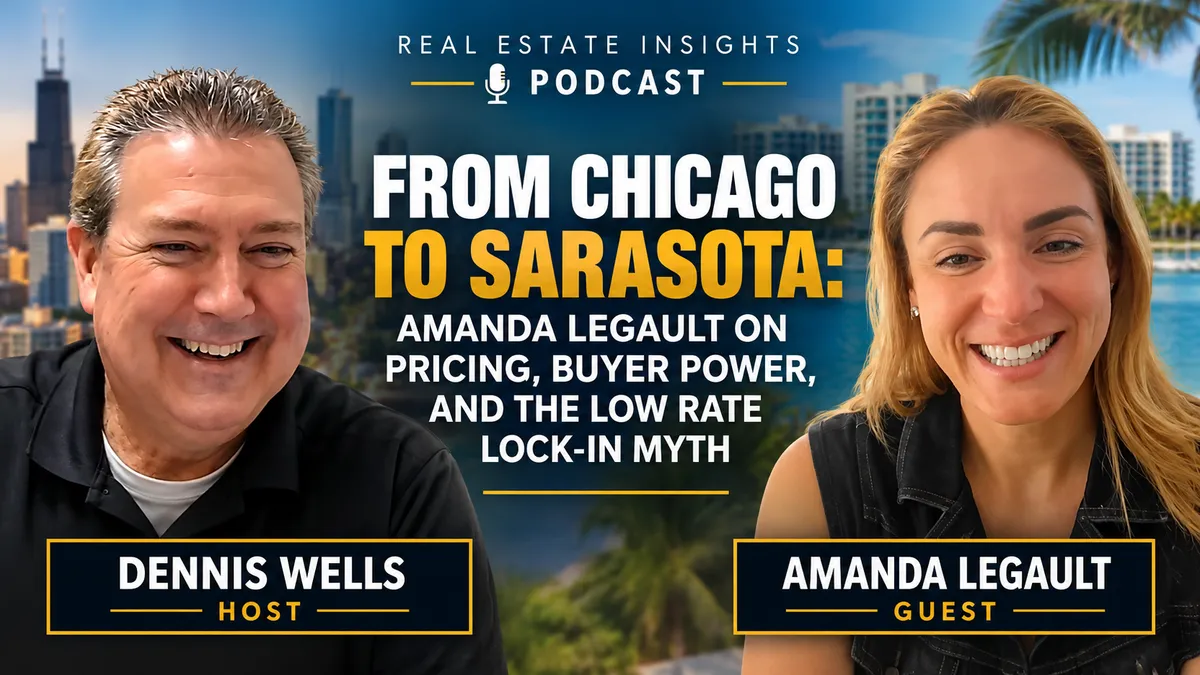
Dennis Wells Talks Sarasota Market Strategy Staging and Seller Reality With KW’s Amanda LeGault
The Chicago Property Manager Who Started Over in Florida and Never Looked Back
Dennis Wells welcomed Amanda LeGault of Keller Williams on the Water in Sarasota to the podcast for a conversation about what five years in the Florida market has taught her, why sellers are still struggling with post-COVID expectations, what buyers in the current environment are actually getting that they did not have two years ago, and how a childhood spent watching her mother stage homes in the Chicago suburbs became the foundation for one of her most valuable professional skills.
Amanda’s path to becoming a Florida realtor is genuinely unusual. Her mother was a stager in the Chicago suburbs and Amanda grew up watching furniture get moved, homes get prepared, and spaces get transformed for sale. That upbringing left her with an eye for presentation and a household philosophy that carried into everything she did professionally. After studying business she came out of school in 2008 into a market that had nothing to offer. She bartended and did odd jobs before landing in property management with a large Chicago company where she eventually became their senior leasing agent, moving from property to property and opening larger buildings.
The realization that led her to get her broker’s license was a familiar one. She was watching agents come in with clients, appear to do what looked like the easy part, and leave with significant commissions while she handled the paperwork and the operational complexity. She spent two and a half years as a Chicago broker and then at the end of the COVID stretch decided to move to Florida and start completely over. Five years later things are getting better every year and she has no complaints.
What the Florida Market Requires That Chicago Did Not
The dynamic Amanda describes between Chicago and Florida clients is one of the most distinctive elements of how she works. In Chicago agents were expected to stay in their lane. Facilitate the transaction and the clients would handle everything else.
In Florida she is the hub. Clients arriving from out of state are setting up life from scratch. They need a landscaper, an HVAC company, a contractor, a referral for anything that comes up. The trust they place in their agent extends far beyond the transaction because she is often the only professional relationship they have in the area when they arrive. Many of them become genuine friends and she embraces that rather than trying to maintain a purely transactional relationship.
She also notes that Florida introduces categories of complexity that Chicago did not require. Hurricanes. Flooding. Special insurance considerations. Clients who are truly starting over and need someone who can help them understand not just the house they are buying but the community and the systems they are entering.
The Staging Background That Shows Up in Every Listing
Growing up with a staging professional as a mother left Amanda with an instinct for what a home needs to look like to command its best price. She brings that perspective into every listing conversation whether the budget allows for full professional staging or requires a more creative approach.
She notes that rooms can actually look smaller without furniture because buyers struggle to contextualize scale when a space is empty. Virtual staging done well addresses that problem at a fraction of the cost of physical staging and she has had strong results using AI tools to create convincing virtual staging that generates meaningful buyer response online. The goal is always to showcase the home in the best possible light within whatever the client’s budget and situation allow.
What Sellers Need to Hear Right Now
Amanda is direct about the pricing problem she sees consistently in the Sarasota market. Sellers are still holding onto post-COVID expectations and the market has not been willing to support those numbers for some time.
Her position is simple. Come in at the right price from day one. Sellers who enter above market are going to sit, accumulate stigma, and end up chasing the market down over time rather than capturing what a well-priced listing would have produced from the beginning. She has walked away from listings where she and the seller could not get on the same page about price because she is in the business of selling houses not carrying overpriced inventory for months.
She also emphasizes understanding the seller’s actual motivation. Why do they need to move and by when? The answer to that question shapes the entire strategy including how aggressively to price and what concessions are worth making.
What Buyers Are Getting Right Now That They Did Not Have Two Years Ago
Amanda’s advice to buyers mirrors what Dennis sees from the lending side. The current rate environment is higher than anyone would prefer but it has produced negotiating power that was completely absent during the competitive peak years.
Buyers are not in multiple-offer situations on most properties. Sellers are willing to negotiate on price, on closing costs, on repairs that surface in inspections. Inspection findings that would have been ignored or rejected out of hand during the frenzy are now being addressed because sellers want the transaction to close. More inventory means more choices and more time to make a thoughtful decision rather than committing sight unseen.
She makes the refinancing point directly. The rate is not permanent. If rates improve the buyer refinances and captures the benefit while keeping the equity built since closing. The purchase price is permanent. Waiting for a better rate environment while prices move upward may produce a worse financial outcome than buying now at a higher rate and a more negotiable price.
The Two Percent Rate Lock-In Question Dennis Uses to Show a Bigger Picture
Dennis shares the consultation framework he uses for homeowners who feel locked in by a low rate they are afraid to give up. The question is not whether the rate is low. It is whether the house still meets their needs and what the complete financial picture looks like if they make a change.
He walks through the math for a hypothetical client. Sell the primary residence and capture tax-free equity up to five hundred thousand dollars for a married couple who have lived there two of the last five years. Use that equity to pay off all consumer debt including credit cards and auto loans. Take a slightly smaller down payment on the new home but carry no other debt obligations.
Yes the mortgage rate goes up from two percent to something in the sevens. But the total monthly debt expenditure may drop significantly when high-interest consumer debt disappears. All of the mortgage interest is now potentially tax deductible. The cash flow freed up from eliminating that consumer debt can be redirected into investments. Over fifteen years the compounding effect on that redirected cash flow may produce a million or two million dollars in outside investments. The two percent rate was never the whole story. The total financial picture was.
Amanda’s response is immediate. That is exactly the kind of bigger picture that clients do not think to look at because they are in tunnel vision on the single number they understand. Her job is to bring the full view into focus.
The American Dream TV Segment and What It Has Produced
Amanda was approached by American Dream TV after someone recommended her and agreed to do it as an exercise in deliberately making herself uncomfortable for the sake of growth. She gets a segment approximately every sixty days with creative freedom to showcase a property or highlight what makes her community special.
The strategy she has built around the segments goes beyond the content itself. After each segment airs she organizes a watch party at a venue ideally the location featured in the episode. She invites past clients, vendors, friends, and prospective clients. Food, drinks, networking, reconnection. It functions as a series of client appreciation events distributed throughout the year rather than a single annual gathering. The transaction ends but the relationship does not have to and the watch party gives her a reason to bring people back together in a way that feels genuinely celebratory rather than transactional.
She is honest that she does not love being on camera alone. Having friends involved makes it more comfortable. Her parents still ask what time it airs as if there is a scheduled broadcast rather than a streaming link. Some things about the media landscape are still catching up to the people who lived through the old version of television.
How to Reach Amanda LeGault
Call or text 847-899 at the number Amanda provided. Email [email protected]. She is with Keller Williams on the Water in Sarasota and can also be found by searching her name online. She works with buyers, sellers, and investors throughout the Sarasota market including relocation clients, second home buyers, and anyone making the transition from the Midwest to the Gulf Coast.
Dennis Wells works with buyers throughout the Gulf Coast Florida area on mortgage financing and welcomes the kind of complete financial picture conversation that the two percent rate lock-in question opens up. Reach out to Dennis Wells to connect on the lending side of any Sarasota area transaction Amanda is working.
Sources
SarasotaAssociationofRealtors.com
NAR.realtor
MortgageNewsDaily.com
ConsumerFinancialProtectionBureau.gov
Investopedia.com

Mortgage Calculator
See your total mortgage payments using the tool below.
| Year | Interest | Principal | Balance |
|---|