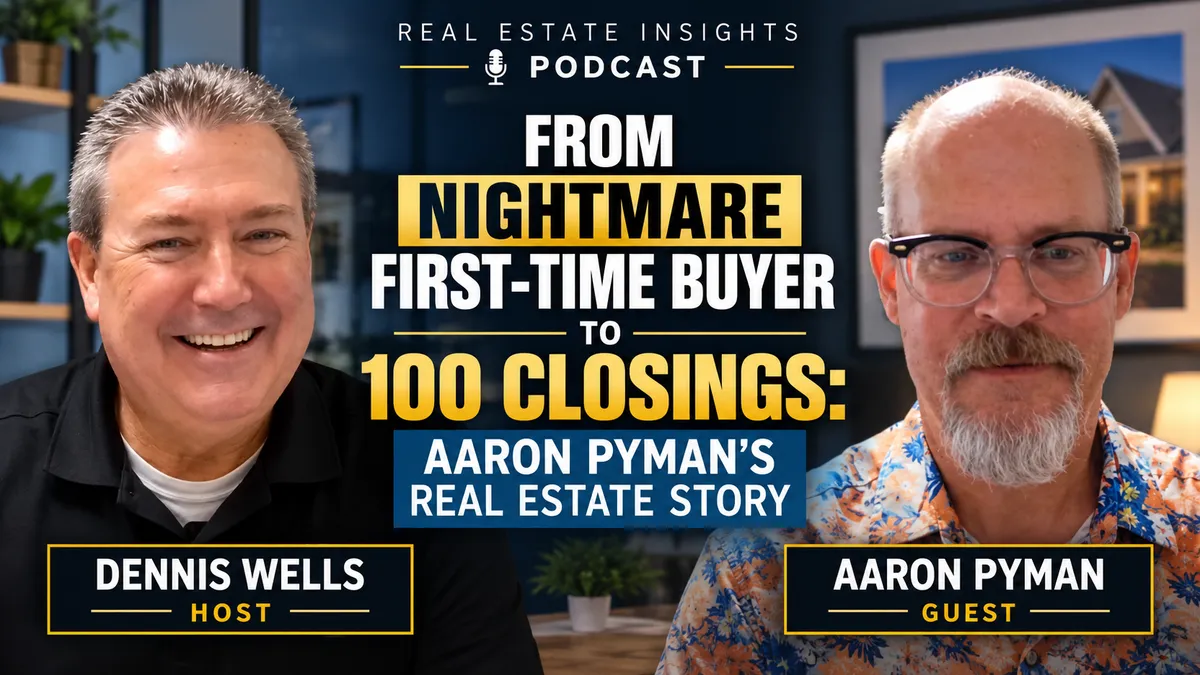
Dennis Wells Talks Southwest Florida Buyer’s Market and Rate Buydowns With Redfin’s Aaron Pyman
The Failed Home Purchase That Created a First-Time Buyer Specialist
Dennis Wells welcomed Aaron Pyman of Redfin in the Sarasota, Florida area to the podcast for a conversation about how a painful personal experience shaped his career, what he is seeing in the Southwest Florida market, and why rate buydowns may be one of the most useful tools available to sellers right now.
Aaron’s origin story is personal. About twelve years ago he and his wife tried to buy their first home, a farmhouse in a small Metro West Massachusetts town. They were using a USDA zero-down loan and were told by the listing agent, who was also acting as their agent, that their upfront costs would be limited to the inspection and appraisal. When the purchase and sale agreement arrived, they were asked for roughly fifteen thousand dollars. Aaron was the only wage earner and his wife has epilepsy, so the number was a serious problem, though they found a way to move forward.
Communication from the agent and the referred lender was poor throughout. Aaron says the seller’s disclosure was not shared with him and the dual agency was not disclosed, both of which were required. Underwriting kept falling apart. Having already given notice on their rental, the couple moved into the home and paid the owners’ mortgage for nine months. They never secured the loan and eventually walked away. Aaron left that experience determined to work with first-time buyers and make sure nobody else went through what he did.
From Sales Career to Eleven Years in Real Estate
After a career in sales, Aaron went into real estate following a startup job that fell apart. He talked at length with a friend who was a realtor, crammed the licensing course, passed on the first attempt, and joined a Century 21 franchise in Massachusetts. In eleven years he has helped close to a hundred people buy their first home. He says it is more personally satisfying than selling computers to hospitals ever was.
The Twelve-Step Email and Why Repeat Buyers Count as First-Timers
Aaron sends first-time buyers a twelve-step email that walks through the whole process, including what to expect, what money is due upfront, and how long each stage takes. He also sends it to anyone who has not bought in five years or more, because the process, the rules, and the numbers change. A buyer who has lived in a home for fifteen years is effectively a first-time buyer again. The checklist and timeline remove much of the anxiety because people know what is coming next.
Why Veterans Make Great Buyers
Aaron and Dennis both enjoy working with veteran buyers. Dennis points out that the common belief that VA borrowers cannot afford much is wrong. Veterans on average carry higher credit scores than conventional buyers, and they have cash like anyone else. The difference is that they are not required to bring it as a down payment. VA appraisals also tend to produce fewer value problems. Aaron adds that veteran clients tend to follow guidance well and respect the process, and in some cases a veteran buyer has won an offer partly because the seller was also a veteran.
What the Southwest Florida Market Looks Like Now
Aaron describes the area as a buyer’s market that has been softening for close to two years after being an epicenter of pandemic price growth. Average days on market are close to one hundred. Price decreases are common, homes are selling around 95% of list price, and seller concessions are everywhere. Well-priced homes still sell quickly.
He expects another six to twelve months of correction, tied to three factors. Interest rates keep many owners with two or three percent mortgages from moving. Homeowners insurance is very expensive. And hurricanes remain a risk, following Ian in 2022 and the combination of Helene, Debby, and Milton in 2024, which hit the barrier islands especially hard. Aaron notes that rebuilding to current code was out of reach for many families, which has accelerated gentrification on the islands. If rates ease and the next hurricane season is mild, he expects buyer demand to pick up.
Rate Buydowns and the Three-to-One Math
Dennis explains that mortgage rates above roughly 6.75% have historically slowed buyer activity, while rates below that level tend to bring it back. A major opportunity right now is negotiating for the seller to fund a rate buydown. Dennis describes the math as about three to one, meaning a ten thousand dollar credit toward the rate can do for a buyer’s payment what a thirty thousand dollar price cut would do, while the seller keeps a higher recorded sale price.
Aaron had not seen the three-to-one comparison and says it makes the case even stronger. He now suggests that sellers considering a price cut of ten or twenty thousand dollars instead put a seller credit for a rate buydown in the first line of the MLS description. First-time buyers often fixate on price or HOA fees, but the monthly payment is what matters, and a buydown can bring it within budget for at least the first years of the loan. It also helps the seller hold their price and protects neighborhood values.
Sellers Who Bought at the Peak
Aaron sees many owners who bought in 2023, 2024, or 2025 and are now underwater. He has told sellers the best he could do was roughly seventy-five thousand dollars below what they paid two years earlier, and he often suggests renting the home and waiting six to twelve months. Builders in the area are throwing incentives at buyers who use their lender and title company, including rate buydowns, closing cost credits, and upgrade credits. In one case a seller who paid about $425,000 could expect $350,000 to $360,000, while a brand new identical home nearby was available for $375,000.
He is equally clear that this is a phenomenal time to buy. Many sellers who flooded in 2024 remediated, repaired, and decided to move closer to family in Wisconsin, Chicago, or Boston. Dennis adds that buying only makes sense for people planning to stay four or five years, and Aaron agrees, noting that renting is cheaper than buying in many parts of the area now. For buyers who need to sell before they buy, the process is difficult at the current speed of the market, and he recommends buying first whenever possible.
One important caveat is the luxury market. Aaron says it remains strong in Sarasota, with island homes and downtown condos performing well. When he filtered MLS data to single family homes under $500,000 he saw roughly a 3% year over year decline, while the high end showed very different numbers.
Emotional Equity and the Coming Soon Tool
Dennis and Aaron discuss how builders see a house as a product with no emotional attachment, while sellers carry years of holidays and birthdays in their homes. Aaron calls this emotional equity. People feel their home is worth more because of the work they put in, but the market decides the value.
For pricing, Aaron uses a Coming Soon tool in his MLS that offers fourteen days of exposure before the listing goes live. The home can have showings, open houses, and a yard sign, and it is syndicated to Zillow, Redfin, and Home.com, but days on market do not accumulate. When the listing goes live on day fourteen it shows zero days on market and no price change history. He uses the window to test the market. In one case, six showings and about a dozen open house visitors produced no offers, which told him people loved the house but not the price. He lowered the price before going live and discussed a rate buydown. If a listing gets nowhere after a month or two, he is comfortable canceling and relisting after the sixty-day clock.
AI, CMAs, and Why the Human Side Still Matters
Aaron uses AI tools alongside his own judgment, the Realtors Property Resource tool, and manual comps when building a CMA. The ranges differ, so he has one AI synthesize them into a recommendation, then verifies every comp because AI can get sale prices and dates wrong. He and Dennis agree that automated valuation models miss things like a new roof, an added bedroom, a pool, or new flooring. Neither expects AI to replace the person who walks the house, reads the situation, and talks through someone’s hopes.
Aaron describes the job as three parts: sales, which includes showing homes and writing contracts; project management, which is coordinating everything under contract; and psychology, which means calming people down and shielding clients from stressed listing agents. He says the psychology piece is why many people fail in the business.
Why a Massachusetts Farmhouse Led to Florida
During the record-breaking winter of 2015, with about a hundred inches of snow, Aaron was wading through waist-deep snow at six in the morning to feed goats and chickens, and snow at the end of the driveway sometimes kept his stepdaughter from getting to school. His wife suggested moving to Florida, and since the family are big Disney fans who visited every Christmas, the decision was easy. They moved after his stepdaughter graduated.
Amendment 3 and What Excites Him Now
Asked about Florida’s Amendment 3 on property taxes, Aaron said he plans to vote no. He estimated the average Sarasota homeowner would save around a hundred dollars a month, and he believes the lost revenue would come back through higher fees and reduced services. He also feels the amendment is poorly written and shifts power to Tallahassee. Dennis noted there are many perspectives on the topic and that it is not as cut and dry as some think. Voters should review the amendment and the arguments on each side.
What excites Aaron most is opportunity for buyers. A first-time buyer south of Sarasota in Northport or Port Charlotte can buy a new three bedroom, two bath, 1,700 square foot home with a garage for around $270,000. He believes buyers who plan to stay five to ten years will have equity and options when they decide to move, since markets fall faster than they recover but do recover.
How to Reach Aaron Pyman
Aaron’s email is [email protected] and his cell is 978-265-6548. He kept his Massachusetts area code.
Dennis Wells works with buyers across Gulf Coast Florida on mortgage financing, including rate buydown strategies that help buyers reach the payment they want. Reach out to Dennis to talk through how a seller credit could work on your next purchase.
Sources
SarasotaAssociationofRealtors.com
Realtor.com
Redfin.com
FloridaRealtors.org
ConsumerFinancialProtectionBureau.gov
